
In 2026, writing has changed forever. The days of staring at a blank screen for hours, waiting for the “perfect” sentence to arrive, are officially over. AI writing tools have transformed the act of drafting from a slow, manual labor into a high-speed, collaborative process.
However, as the internet floods with AI-generated text, a new challenge has emerged: How do you use AI to write faster without sounding like a robot? The creators who win in 2026 aren’t just using AI to “fill space”—they are using it to amplify their expertise and build deeper connections with their audience.
Why “Prompting” is the New “Writing”
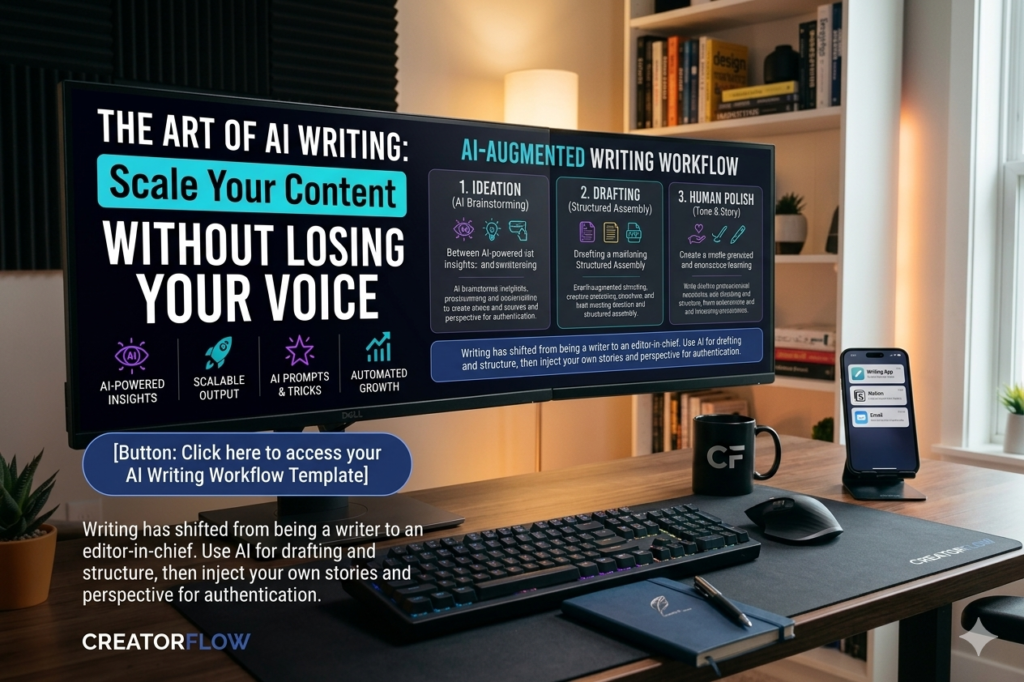
Writing has always been about communication. With AI, your role has shifted from being a “writer” to an “editor-in-chief.” When you work with an AI assistant, you aren’t outsourcing your thought process; you are externalizing your internal monologue.
If you give an AI a vague prompt like “Write a blog post about productivity,” you will get a generic, lifeless response. But if you provide a prompt like, “Write a guide on time-blocking for solopreneurs, using a conversational, witty tone, emphasizing the struggle of balancing deep work with client calls,” you get a draft that actually sounds like you.
The 3 Stages of AI-Augmented Writing
To scale your content production while maintaining high quality, follow this three-stage framework:
-
The Ideation Phase: Use AI to brainstorm angles you haven’t considered. Ask it, “What are five counter-intuitive perspectives on [your topic]?” This helps you break through creative blocks and find unique hooks.
-
The Drafting Phase: Don’t ask the AI to write the whole article at once. Break it down into sections. Draft your “Introduction” first, then your “Key Points,” then your “Conclusion.” This allows you to guide the AI’s flow and ensure the logic remains sound.
-
The Human Polish: This is the most critical step. AI can provide the information, but it cannot provide your story. Add personal anecdotes, specific examples from your life, and emotional nuance. This is the “human salt” that makes your writing taste authentic.
Breaking the “Robotic” Trap
Readers are smarter than ever. They can spot “AI-speak” from a mile away—think of overused words like “delve,” “unleash,” “game-changer,” or “tapestry.”
To keep your AI writing human, do these three things:
-
Use Short Sentences: AI loves long, flowery paragraphs. Cut them in half.
-
Inject Opinion: AI is trained to be neutral. You aren’t. State your opinion clearly and back it up with your own reasoning.
-
Vary Your Rhythm: Add questions, punchy one-sentence paragraphs, and conversational transitions. Treat your text like a conversation, not a textbook.
The Competitive Advantage of Volume
When you master AI writing, you unlock a superpower: Volume without Burnout. In 2026, the creator who publishes high-quality content consistently is the one who wins the algorithm. With AI, you can take one core idea and expand it into a blog post, a newsletter, a LinkedIn thread, and a script for a short video—all in a fraction of the time it used to take to write just one post. You aren’t just creating more; you are creating more value for more people.
Building Your “Content Engine”
If you want to treat your content like a business, you need an engine. You need a system that ensures your tone is consistent, your facts are checked, and your output remains high.
Ready to master the craft of AI-assisted writing? I’ve created an “AI Writing Workflow Template,” which includes my favorite system for prompting, editing, and fact-checking. This is the exact workflow I use to produce high-value content every single week. Stop struggling to find the right words and start using the right system.
[ Click here to access your AI Writing Workflow]
Final Thoughts
AI is not a threat to your creativity; it is the ultimate tool for the modern creator. It handles the heavy lifting, the grammar, the structure, and the research, so you can focus on the heart of the message: your perspective.
The future belongs to the writers who embrace technology, not those who hide from it. Don’t wait for your competition to figure this out before you do. Build your AI writing system now, reclaim your time, and start sharing your voice with the world at scale.